
ODOC Inmate Population Overview
ODOC is the official abbreviation used by the Oklahoma Department of Corrections on Oklahoma.gov pages, newsroom items, facilities pages, offender information, and policy material. ODOC runs the state prison and community-supervision system. It does not operate each county jail. That distinction drives the ODOC inmate population page: state prison and ODOC supervision searches belong in OK Offender Lookup, while new arrests and pretrial jail custody belong with the county jail or city detention source that booked the person.
ODOC's headquarters contact block in the research lists 4345 North Lincoln Blvd., Oklahoma City, OK 73105, phone 405-425-2500, and mailing address PO Box 11400, Oklahoma City, OK 73136-0400. The ODOC homepage links offender lookup, sex-offender lookup, violent-offender lookup, PREA, policies and procedures, open-records requests, inmate medical records requests, and a data request form.
The Oklahoma Department of Corrections homepage is the agency identity and records-routing source for ODOC inmate population work.
That page is where ODOC connects the public to offender lookup, open records, medical records, data requests, policies, and facility information.
ODOC Inmate Population Count
The strongest current population anchor in the research is ODOC's Daily Statewide Population Report for June 29, 2026. It listed a DOC subtotal of 22,328 people against 22,733 operational capacity, with 596 vacant beds and 97 percent capacity. The same count sheet listed 1,358 people in county-jail backlog and a grand total of 23,855 after adding backlog, fugitives, interstate compact out-of-state, and out-to-other-jurisdiction categories.
The ODOC inmate population was higher in mid-2026 than in mid-2025. ODOC's June 23, 2025 weekly count listed a DOC subtotal of 21,600. The June 29, 2026 report listed 22,328, an increase of 728 people in about one year. The county-jail backlog also rose from 1,186 on January 6, 2025 to 1,358 on June 29, 2026. That backlog is an ODOC count category, not a complete statewide jail roster.
| ODOC category | June 29, 2026 count | Why it matters |
|---|---|---|
| Assessment and reception | 543 | Entry and evaluation tier for state custody |
| State institutions | 20,235 | Core Oklahoma prison population |
| Community centers | 1,431 | Community custody, reentry, and work-release settings |
| Bridgeway Halfway House | 119 | Contract halfway-house placement listed by ODOC |
| County-jail backlog | 1,358 | Sentenced ODOC custody waiting in county jail or outside prison placement |
ODOC Inmate Search
ODOC OK Offender Lookup is the public search channel for Oklahoma state custody. The current page says the lookup was recently updated and uses a new data source. It also warns that ODOC assumes no legal liability for accuracy or completeness, that sentence and offense information is abbreviated, and that the lookup is not intended to give an exact explanation of the offense, sentence details, or time to be served.
Use the ODOC inmate locator when the person has been sentenced to state custody, assigned to reception, moved to a state prison or community corrections center, listed as an ODOC fugitive, or appears under ODOC supervision. Do not use it as the first stop for a same-day arrest, a municipal hold, a county warrant, or someone still awaiting first appearance. For those searches, start with the local county roster.
- Open ODOC OK Offender Lookup and accept the lookup terms if the system requires it.
- Search by ODOC number when available, since it is more precise than a common name.
- When searching by name, compare age, facility, court, sentence, conviction, CRF number, or statute details when the interface provides those fields.
- Read the result as a custody and sentence summary, not a complete court file.
- If the person is not found, check the county jail roster, VINELink, BOP, ICE, OSCN or ODCR, and the sheriff or jail that may hold the person.
The direct ODOC offender-search path is the practical search entry documented in the research.
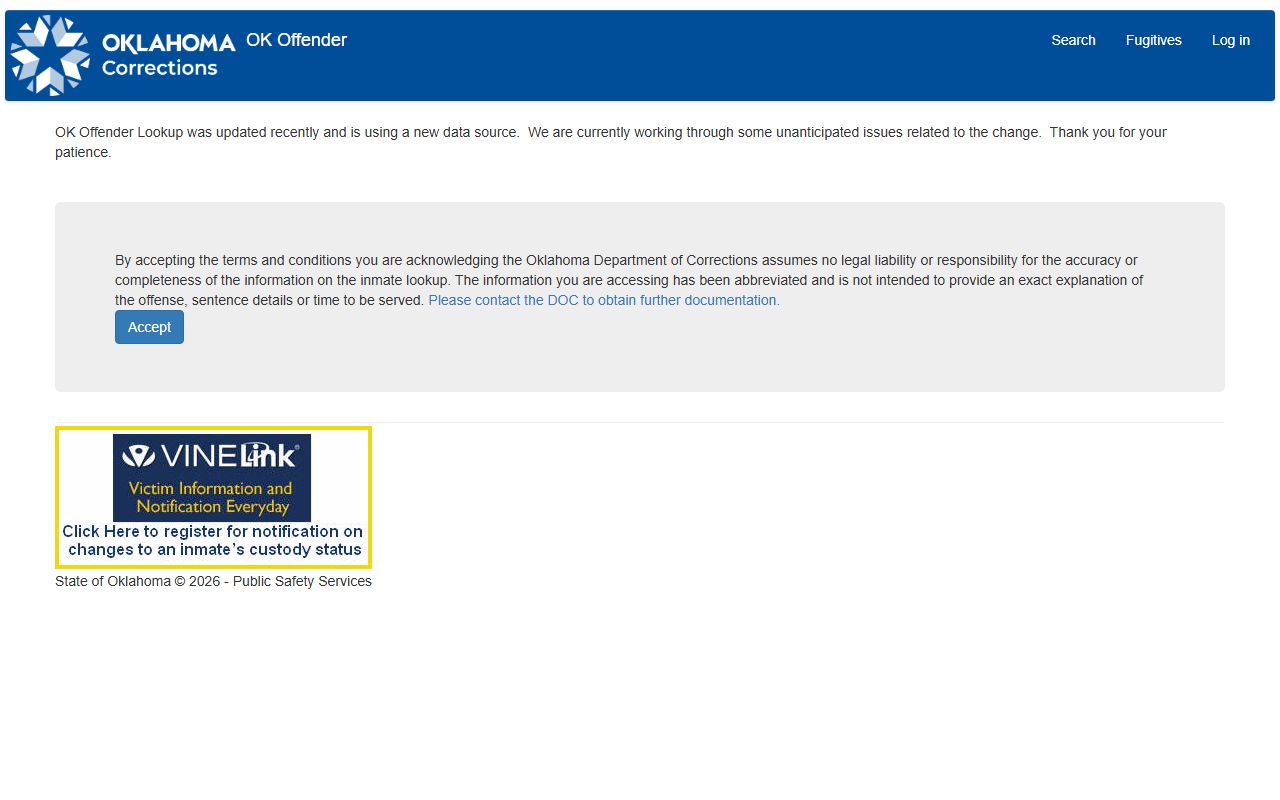
The direct search page still carries ODOC's disclaimer about abbreviated information and accuracy limits.
ODOC Locator Search Fields
ODOC's 2017 release about the online inmate lookup remains useful for field vocabulary, even though the current lookup says it has been updated and uses a new data source. ODOC described the lookup as a public tool for inmates sentenced to state prisons and said searches could be based on appearance, facility, sentence, conviction date, court, CRF number, term code, statute, and statute code. The current page may not expose every field in the same way, so the safest language is that ODOC has documented those search dimensions, not that every screen always displays them.
| Search dimension | Use | Limit |
|---|---|---|
| ODOC number or identity | Best match path when known | Name spelling and aliases can affect results |
| Facility | Helps narrow current placement | Transfers may not be shown before data updates |
| Sentence or conviction details | Helps distinguish people with similar names | ODOC says sentence data is abbreviated |
| Court, CRF, statute, term code | Connects prison record to court-source facts | Court dockets still need OSCN, ODCR, or the clerk |
The ODOC lookup-feature release documents the broader search dimensions ODOC promoted for the public lookup.
Those field names help users understand why a court case number or statute can matter even when the goal is custody search.
ODOC Facilities and Security
ODOC's current facilities directory and count sheets define the Oklahoma state prison landscape. The research lists state institutions such as Allen Gamble Correctional Center, Dick Conner Correctional Center, Great Plains Correctional Center, Joseph Harp Correctional Center, Oklahoma State Penitentiary, Oklahoma State Reformatory, Red Rock Correctional Center, Lexington Assessment and Reception Center, Mabel Bassett Correctional Center, and several minimum-security and community corrections sites. It also identifies Bridgeway, Inc. Halfway House as a contract halfway-house listing in Ponca City.
ODOC says its four security levels are maximum, medium, minimum, and community. Oklahoma State Penitentiary is the maximum-security anchor and death row site in the research. Community corrections centers include Clara Waters, Enid, Lawton, Northeast Oklahoma, and Union City, with Dr. Eddie Warrior community-center capacity also appearing in the count-sheet category. A county jail should not be described with ODOC security-level language unless the county research supports it.
The ODOC facilities directory lists institutions, community corrections, contract facility material, and weekly count links.
That directory also helps reconcile renamed facilities such as Davis to Allen Gamble and Lawton to Red Rock.
ODOC Sentences and Release
Oklahoma sentence calculation is controlled by the judgment and sentence, state statutes, and ODOC policy. ODOC's Sentence Administration policy says sentences are administered under the judgment and sentence issued by the district court and statutory authority. The general-counsel sentence-service document explains that ODOC maintains offenders remanded to custody for the duration of confinement or supervision and that sentences are served under Oklahoma statute and case law.
The 85 percent rule is one of the most important Oklahoma-specific limits. Title 21, Section 13.1 lists offenses for which a person must serve not less than 85 percent of the sentence before parole consideration, and the statute says credits may not reduce those sentences below that level. Earned-credit rules and restoration of removed credits are generally tied to Title 57, Section 138 and ODOC policy, but the page should not be used to calculate a release date.
Parole is handled by the Oklahoma Pardon and Parole Board, not ODOC alone. The board's homepage describes its mission, and its docket search can use docket month and year, DOC number, last name, and county filters. A parole docket listing is not a release order. ODOC also states that release dates are confidential unless the requester has a legitimate need, and transfer dates are not provided for confidentiality and security reasons.
- County-jail backlog
- Sentenced ODOC custody that may still be physically housed in a county jail while awaiting reception or transport.
- Community corrections
- Still ODOC custody, often tied to reentry, public works, work-release, or supervision settings.
- Parole docket
- A board process record, not proof that a person has been or will be released.
ODOC Records Requests
For ODOC records, use ODOC's own open-records, inmate medical-records, and data-request links. For a county booking, jail incident, mugshot, local roster correction, or detention-center video, start with the sheriff, jail trust, city police department, or county detention center that created the record. Oklahoma's Open Records Act is the statewide public-records framework, and 51 O.S. Section 24A.8 is the law-enforcement-records section cited in the research.
ODOC records are not the same as court records. A court portal such as OSCN or ODCR can show filed charges, hearings, dispositions, and docket activity. ODOC lookup shows prison or custody information in abbreviated form. For a full legal case history, check the court source. For current prison custody, check ODOC. For a recent booking, check the county roster.
Public inmate/offender data also has a statewide data-request path through ODOC's media and public-data material. That route is different from asking a local sheriff for a booking sheet or asking a court clerk for a criminal case docket. Use ODOC when the record concerns a state prison incident, ODOC policy, ODOC count data, ODOC operations, state custody, or an ODOC offender data extract. Use the county when the record was created by a jail, city police department, or detention center before state custody began.
Note: ODOC release dates and transfer dates are restricted, so the locator and records process should not be treated as a release-date calculator.
The ODOC visitation page explains that visits must be scheduled, walk-ins are not allowed, and requests are due by Wednesday at 1 p.m.
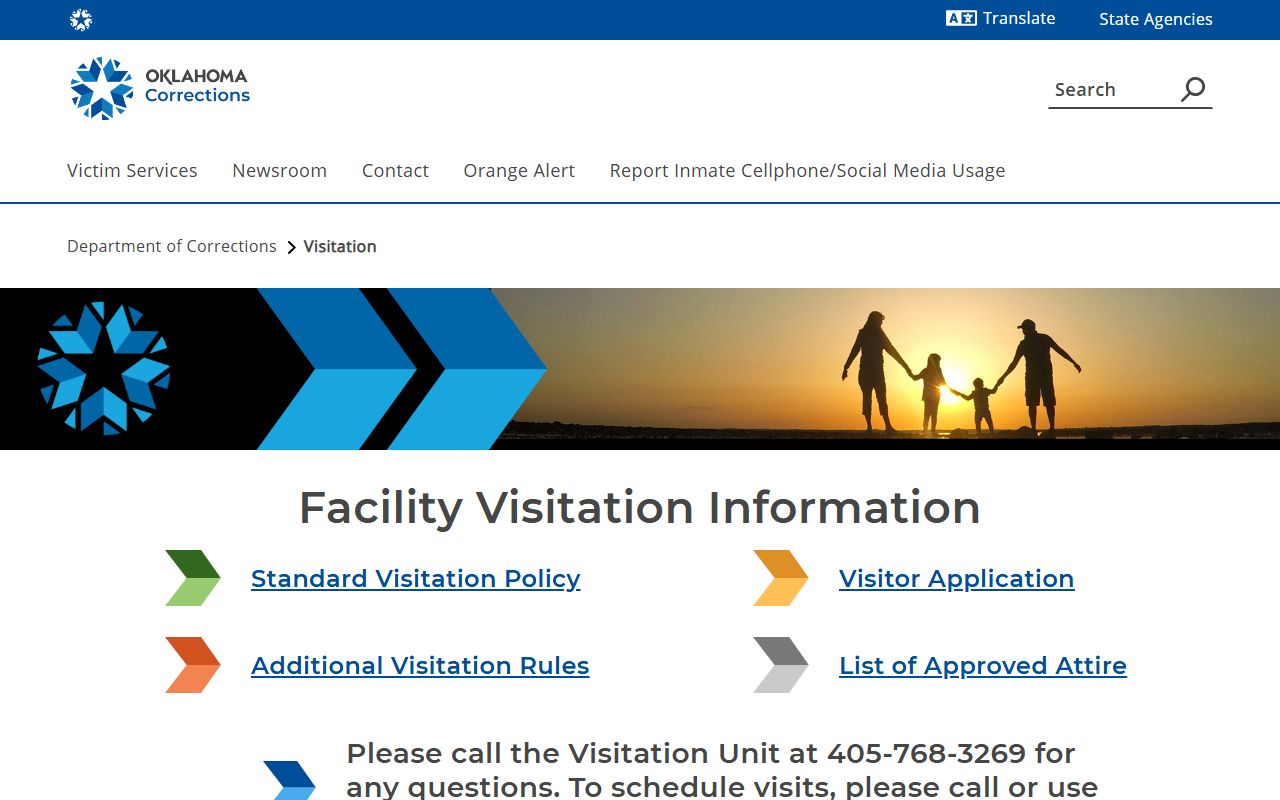
Visitation, mail, and money rules belong to the specific ODOC facility once the locator confirms placement.
Public Record Search
Sponsored Results