
Oklahoma Court Records After Arrest
After a jail arrest in Oklahoma, the booking record and the court record do not always appear at the same time or say the same thing. The arresting agency and jail create custody records first. The prosecutor then decides what charge to file, whether to amend the charge, whether to decline a count, and how the case should move. Once filed, the court record tracks the charge list, case number, docket activity, hearing dates, warrants, bond orders, pleas, dismissals, convictions, or other disposition entries.
The custody side belongs with Oklahoma inmate records. Booking-photo questions belong with Oklahoma jail rosters and mugshots. The court side belongs with Oklahoma court-access tools and the local court clerk for the county where the case was filed. That distinction prevents a common error: treating a jail booking charge as the final charge. Oklahoma research specifically notes that court portals answer what case was filed, what charges appear in the docket, what hearings are set, and what disposition has been entered.
Oklahoma Criminal Case Access
Oklahoma has two practical statewide court-record access channels in the research. The Oklahoma State Courts Network docket search is the official OSCN docket-search URL, although the statewide research pass saw an automated-traffic verification screen. On Demand Court Records, or ODCR, is a public portal for participating courts. ODCR's static content describes public court records from participating Oklahoma District Courts, tribal courts, and all listed counties, with fields such as party name, party type, court group, case type, full case number, filed date, and activity date.
The On Demand Court Records public search screenshot shows the ODCR participating-court portal and the kinds of search fields used for Oklahoma court records after an arrest.
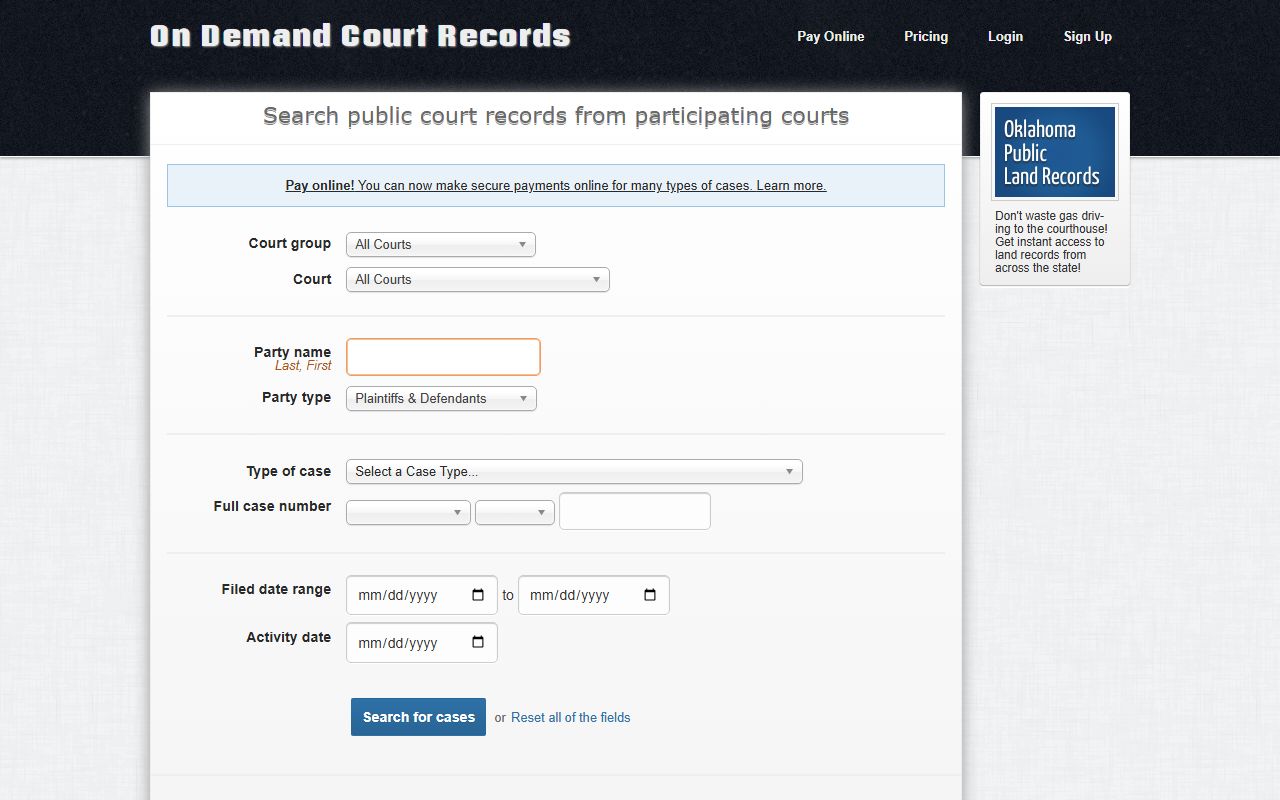
ODCR is useful for filed cases, but participating-court coverage and field behavior should be checked against the county and case type involved.
Search Court Records After Arrest
A court-record search works best when the county is known. County matters because the arrest, booking, prosecution, and clerk record are tied to where the case is filed. Use the County Directory when the booking county is known but the local roster or clerk route is not. Use the court tools for filed charges, not for live custody. If the person is still in jail, search the jail roster too.
- Confirm the arrest or booking county through the local jail roster, VINELink, a booking report, or a court docket clue.
- Open ODCR or OSCN docket search and search by party name, full case number, or available case details.
- Open the criminal case result and compare the filed charge list with the booking charge or hold reason.
- Check docket activity for bond orders, warrants, amended filings, dismissal entries, plea entries, or sentencing entries.
- For current custody after a filed case, return to the county roster, ODOC lookup, BOP, ICE, or VINELink as the custody system requires.
The OSCN docket-search URL screenshot captured the statewide docket-search access point, even though the research pass reached an automated-traffic verification screen.
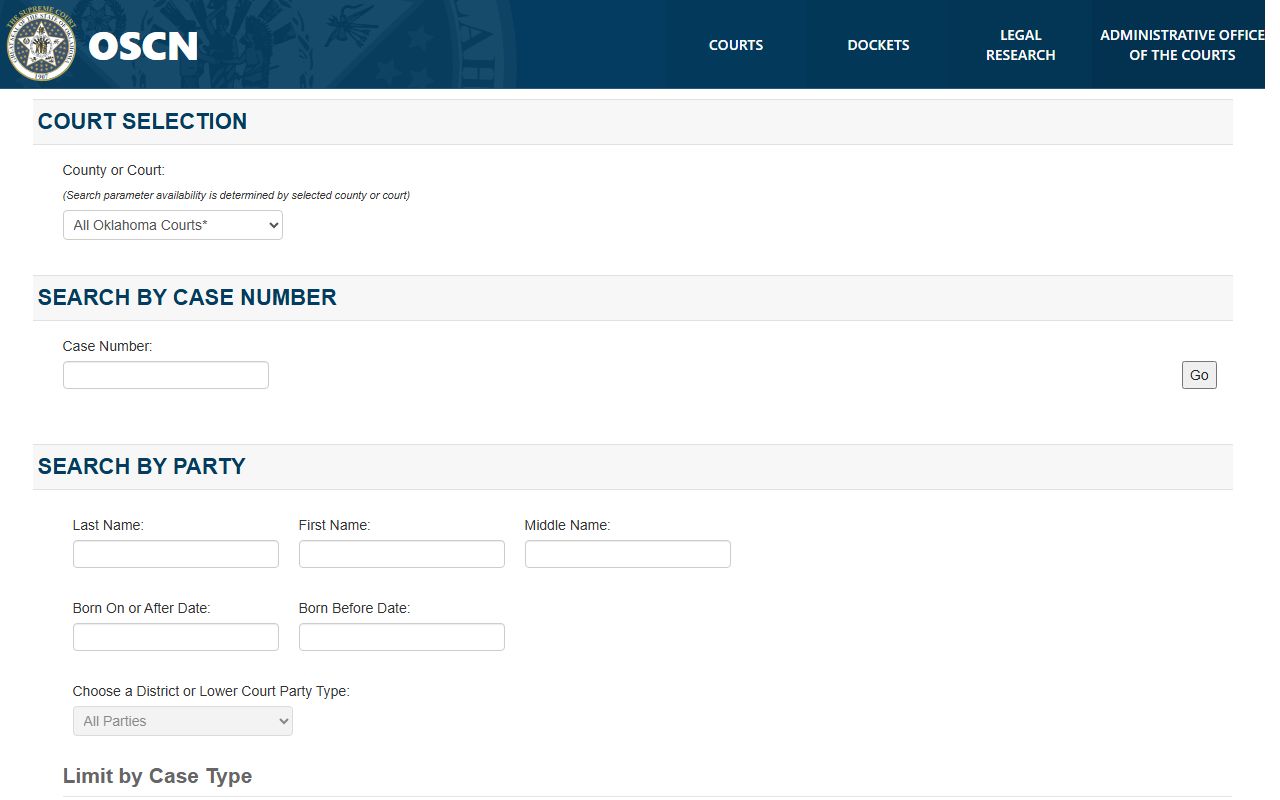
That capture is still relevant because OSCN remains a documented Oklahoma docket-search channel, while ODCR provides another public search route for participating courts.
Charges Filed After Arrest
The court record starts with a filed accusation, not with the booking photo or jail intake entry. Oklahoma research frames the path as arrest, booking, first appearance, prosecutor filing, and then a case record. The exact filing type and sequence can vary by case, but the important public-record point is stable: a charge on the jail roster is a custody clue, while a charge in the court record is the filed case information that will be amended, dismissed, reduced, tried, pleaded, or sentenced.
| Document | What It Does | How to Read It |
|---|---|---|
| Complaint | Starts or supports a criminal accusation in the court record. | Use it as the filed-case entry, not as proof of conviction. |
| Information | States the prosecutor's filed criminal charge in many Oklahoma cases. | Compare it with later amended filings or dismissal entries. |
| Indictment | Reflects a grand-jury charging route when that path is used. | Read later docket entries to see whether charges changed. |
Oklahoma Charge Status Terms
Charge status can change after a jail arrest. A booking may list a broad arrest reason or warrant. The filed case may narrow, expand, or replace that wording. Later docket activity may show an amended information, a dismissal, a plea, a conviction, a sentence, or a warrant event. Oklahoma court records should be read chronologically, because the newest docket entry often gives better status context than the first arrest or filing entry.
| Status | What It Means |
|---|---|
| Pending | The case remains active and no final disposition is shown in the public docket entry being reviewed. |
| Amended or reduced | The prosecutor or court record changed the charge wording, count, level, or filed theory after the first entry. |
| Dismissed | A charge or case was ended without a conviction on that count, subject to the exact docket language. |
| Nolle prosequi | The prosecutor declined to continue a charge, when that term appears in the case record. |
| Disposed | The court record shows a result such as plea, finding, dismissal, sentence, or other final action. |
Bond After Oklahoma Arrest
Bond connects the jail record and the court record. A jail roster may show bond or a hold. The court docket may show bond orders, warrant orders, release conditions, or later changes. A no-bond hold, another-agency detainer, ODOC transfer status, federal custody, or ICE detention can make a simple roster search misleading. When bond information conflicts, the holding facility and current court order should be checked before relying on an older public entry.
| Bond or Hold Type | How It Works in Records |
|---|---|
| Cash bond | A cash amount may appear on a roster or docket as a release condition set by the court. |
| Surety bond | A bondsman-backed release may be reflected in court activity or jail release status. |
| Personal recognizance | Release may be ordered without a cash deposit when the court permits that form of release. |
| No-bond hold | The person may remain in custody because release is not available on that hold or warrant entry. |
| Detainer | Another agency or jurisdiction may hold the person even when the local charge changes. |
Charges vs Convictions
A charge after an Oklahoma jail arrest is an accusation in a criminal case. A conviction is a later result through plea, finding, or verdict. Court records can show both, but they are not the same thing. A person may be arrested and charged, then have one count dismissed, another count amended, or no conviction entered on the original booking language.
| Charge | Conviction | |
|---|---|---|
| Record stage | Filed accusation or count after arrest. | Result after plea, finding, or verdict. |
| What it proves | That a charge was filed or alleged. | That guilt or a qualifying plea/result was entered. |
| Where it appears | Jail roster, complaint, information, indictment, or docket. | Disposition, judgment, sentence, or later docket entry. |
Important: A jail arrest or filed charge is not the same as a conviction, and public lookup results should not be used as an FCRA background check.
Sealed or Expunged Oklahoma Records
Oklahoma research notes that dismissed charges, sealed records, juvenile arrests, active investigations, medical or mental-health information, victim protections, and security concerns can restrict public access. When an eligible Oklahoma arrest or case is sealed or expunged, the public-facing court and jail trail may change. The available research does not provide a full eligibility chart, so the practical public-record point is narrow: a missing record may reflect timing, spelling, county coverage, portal participation, or a legal restriction.
| Sealed | Expunged | |
|---|---|---|
| Public visibility | Hidden or restricted from ordinary public access when a court order or law applies. | Treated as cleared from ordinary public view when the proper legal process applies. |
| Agency handling | Access may remain for agencies or limited legal uses. | Agency and court handling depends on the order and the record type. |
| Search effect | The case may not appear in a public portal. | Older jail or court references may need agency review or legal correction. |
Custody Alerts and Court Records
VINELink and OK VINE help with custody-status notification, but they do not replace the court record. The Oklahoma Attorney General describes OK VINE as a 24-hour confidential computer-assisted service that provides access to offender custody status. Users may check status through VINELink, the mobile app, phone, email, text, or TTY notifications. The AG page gives registration phone 1-877-654-8463 and OK VINE training or information phone 405-521-3921.
The Oklahoma Attorney General OK VINE page screenshot shows the statewide custody-notification explanation and registration channels.
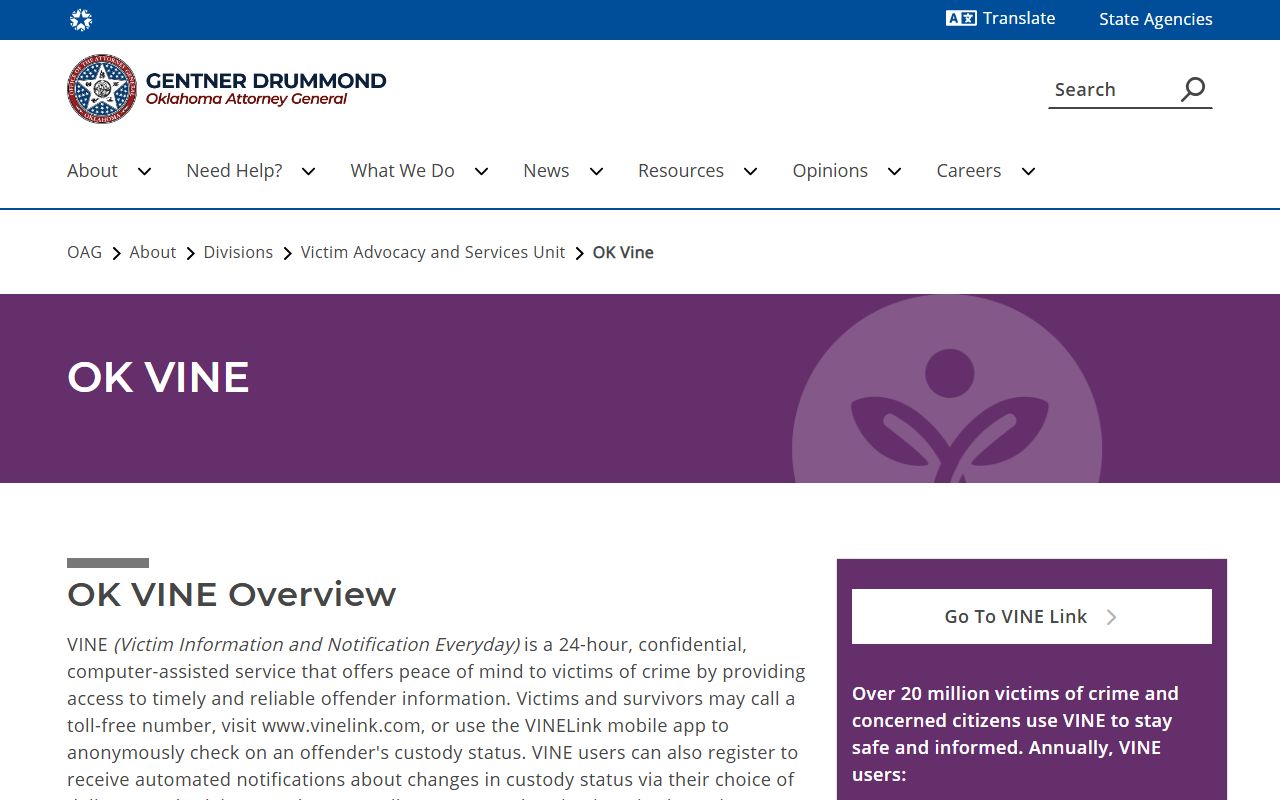
That source fits post-arrest research because a case may keep moving in court while custody status changes by release, transfer, or another-agency hold.
Restricted Arrest Court Records
Oklahoma's Open Records Act, Title 51, Sections 24A.1 through 24A.30, is the statewide public-records base. Section 24A.8 is the researched starting point for law-enforcement records. The same research warns that some law-enforcement, jail, prison, or court material may be withheld or redacted for statutory exceptions, open investigations, juvenile confidentiality, medical and mental-health privacy, victim protections, or security reasons. ODOC release dates are also restricted unless the inquirer has a legitimate need.
For a court record after an arrest, search ODCR or OSCN first, then ask the correct county clerk when the public portal does not answer the filing question. For the jail record, ask the sheriff, jail trust, city police department, or detention center that created the booking record. For ODOC records, use ODOC open-records, medical-records, or data-request channels from the ODOC homepage.
The Oklahoma Department of Corrections homepage screenshot shows the statewide ODOC links for offender lookup, open records, policies, data requests, and related correctional records.
ODOC is relevant only when the record is a state correctional record, not when the request is for a county booking or a court clerk case file.