
How Oklahoma Inmate Records Work
Oklahoma does not have one combined public jail roster for every county. The county jail layer is local. Sheriffs, jail trusts, detention centers, city jails, and vendor roster systems control the records for new bookings, pretrial holds, short local sentences, municipal warrants, and some detainers. That means a person booked in Tulsa County, Oklahoma County, Payne County, or a smaller rural county may be found through a different roster, different search form, and different public-records channel.
The state prison layer is separate. The Oklahoma Department of Corrections, or ODOC, runs the state prison, reception, community corrections, supervision, and state sentence framework. ODOC is not the booking agency for a new county arrest, but ODOC count sheets do include a county-jail backlog for people sentenced to ODOC custody who have not yet moved into a state facility. Oklahoma research captured that backlog as 1,358 people on the ODOC Daily Statewide Population Report dated 06/29/2026. That number is not the total county jail population. It is a state-sentence transition category.
Federal and immigration records add two more layers. The Federal Bureau of Prisons locator covers federal inmates from 1982 to the present, including Oklahoma federal facilities such as FCI El Reno and FTC Oklahoma City. ICE uses the Online Detainee Locator System for current immigration detention. Oklahoma VINE and VINELink are custody notification tools, not full court files or sentence calculators.
Find Oklahoma Inmates Statewide
The right search path depends on timing. If the arrest just happened, start with the county that booked the person. If the case has already reached judgment and sentence, check ODOC. Oklahoma has a documented delay between sentencing and transport. ODOC offender information says that after sentencing, it is normally 6 to 9 months before an offender is scheduled to be transported into ODOC custody, with priority exceptions for certain short sentences and return-to-court or program-completion cases. During that period, both the county roster and ODOC lookup may matter.
- For a new arrest, identify the county or city that booked the person and open the county jail roster from the County Directory.
- For a state sentence, search ODOC OK Offender Lookup or the direct ODOC offender search.
- For federal custody, use the BOP inmate locator, which searches by register number or name.
- For current immigration detention, use the ICE Online Detainee Locator System and the official USA.gov guidance when the locator does not return a match.
- For release or transfer alerts, check Oklahoma VINELink or the Oklahoma Attorney General OK VINE page.
The ODOC OK Offender Lookup screenshot shows the statewide offender search entry point and the disclaimer users must accept before moving into the search.
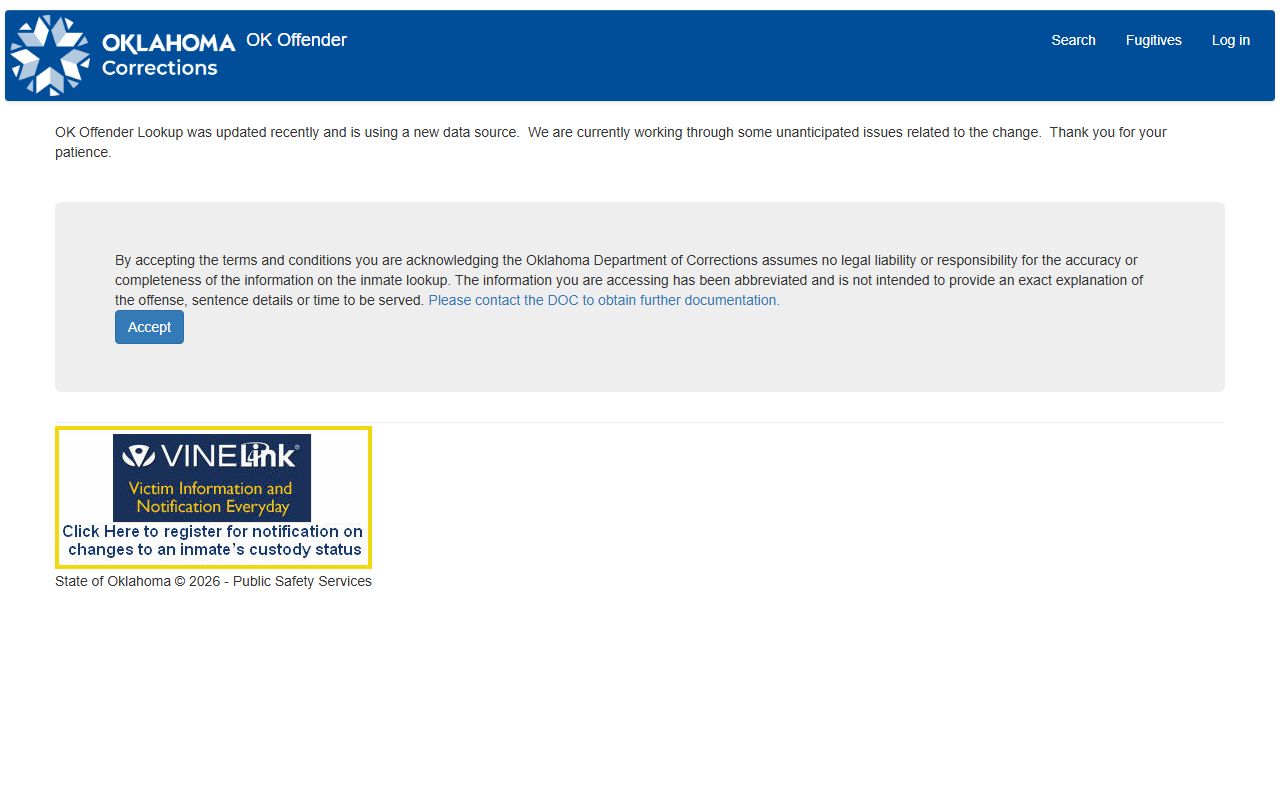
That warning matters because ODOC describes the lookup as abbreviated and not as a full explanation of the offense, sentence details, or time to serve.
Oklahoma Custody Systems
Oklahoma inmate records are clearer when the custody system is named first. A county jail roster is the usual source for pretrial custody and short local holds. ODOC is the source for sentenced state custody, state prison institutions, reception, community corrections, and many supervision contexts. BOP and ICE are federal systems. Court portals show cases, filings, charges, hearings, and disposition, but a court docket is not proof that a person is still in custody.
| Custody | Run By | Where to Look |
|---|---|---|
| Recent arrest, pretrial hold, short local sentence | County sheriff, jail trust, city jail, or detention center | County jail roster through the county page or County Directory |
| Sentenced state prisoner or ODOC supervision | Oklahoma Department of Corrections | ODOC OK Offender Lookup |
| Federal inmate | Federal Bureau of Prisons | BOP inmate locator |
| Current immigration detention | U.S. Immigration and Customs Enforcement | ICE Online Detainee Locator System |
| Custody-status notification | Oklahoma VINE / VINELink | Oklahoma VINELink |
The Federal Bureau of Prisons inmate locator screenshot shows the federal search channel for Oklahoma federal custody and for people who have moved through federal prison since 1982.
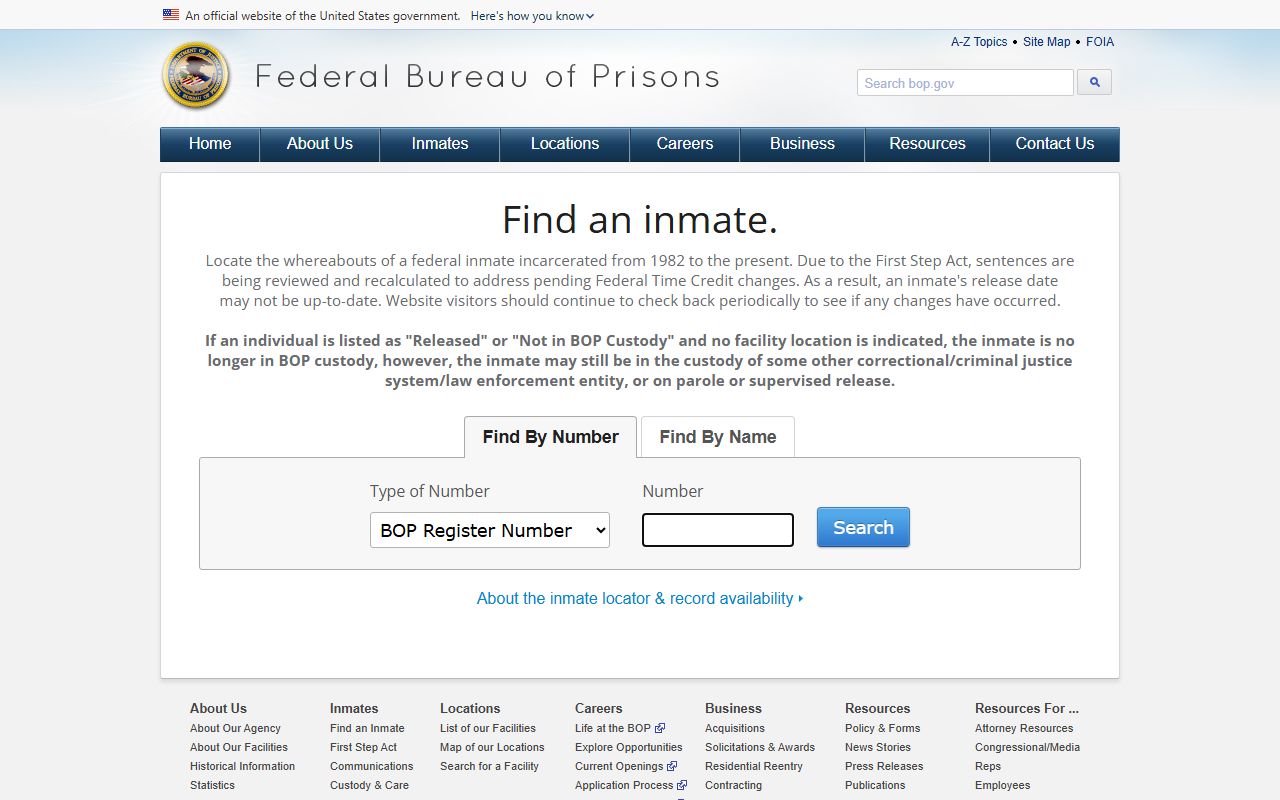
BOP results should not be read as county jail or ODOC results, since federal release status can still leave a person in another custody or supervision system.
Oklahoma Jail Roster Fields
County roster fields vary because Oklahoma jail systems are local and vendor-specific. The state research did not identify a single statewide roster template. County research repeatedly used local rosters, sheriff sites, detention-center portals, jail-trust pages, municipal custody notes, and public-records fallback channels. A useful Oklahoma inmate record search therefore treats roster fields as expected categories, not guaranteed fields.
| Field Label | Type | Common Use | Notes |
|---|---|---|---|
| Name | Text | Primary search and profile identity | Check spelling variants, aliases, suffixes, and hyphenated names when a search fails. |
| Booking or inmate number | Text or number | Roster profile identifier | County booking numbers differ from ODOC numbers and BOP register numbers. |
| Booking date | Date | Timing of the local jail record | Recent bookings may lag behind arrest or first appearance timing. |
| Charges or hold reason | Text | Arrest, warrant, detainer, or filed-case clue | Booking charges can differ from charges later filed by the prosecutor. |
| Bond or release status | Text or amount | Custody and release information | Bond changes may appear first in court records or jail records depending on the county. |
| Facility | Text or dropdown | Physical holding site | Important in counties with city jails, jail trusts, juvenile facilities, or contract housing. |
For state prison records, ODOC has documented broader search dimensions. A 2017 ODOC release described public lookup searches by appearance, facility, sentence, conviction date, court, CRF number, term code, statute, and statute code. Current controls can change, so those fields should be treated as ODOC-documented capabilities rather than a promise that every search screen exposes every option at all times.
Oklahoma Inmate Profile Fields
A roster profile is a custody snapshot. It is not the full police report, the full court file, or a complete sentence calculation. ODOC gives the same kind of caution for its own lookup by warning that sentence and offense information is abbreviated. County rosters can also be delayed, incomplete, or narrowed by local policy, juvenile confidentiality, investigation limits, security rules, or state-law exceptions.
| Field | What It Shows |
|---|---|
| Booking or DOC number | The custody-system identifier, which may be local, ODOC, BOP, or another agency number. |
| Booking or admission date | When the person entered that custody system or when the profile was created. |
| Charges or offense summary | The jail hold reason or ODOC offense summary, often abbreviated and not a full court record. |
| Bond, hold, or sentence status | Release conditions, a detainer, a no-bond hold, or state sentence context when published. |
| Facility or housing | The jail, prison, community corrections center, federal facility, or other holding site shown by the system. |
| Custody status | Whether the person appears in custody, released, transferred, on supervision, or outside the searched system. |
The ODOC release describing online lookup features records the state agency's explanation of how detailed state-prison searches were intended to work.
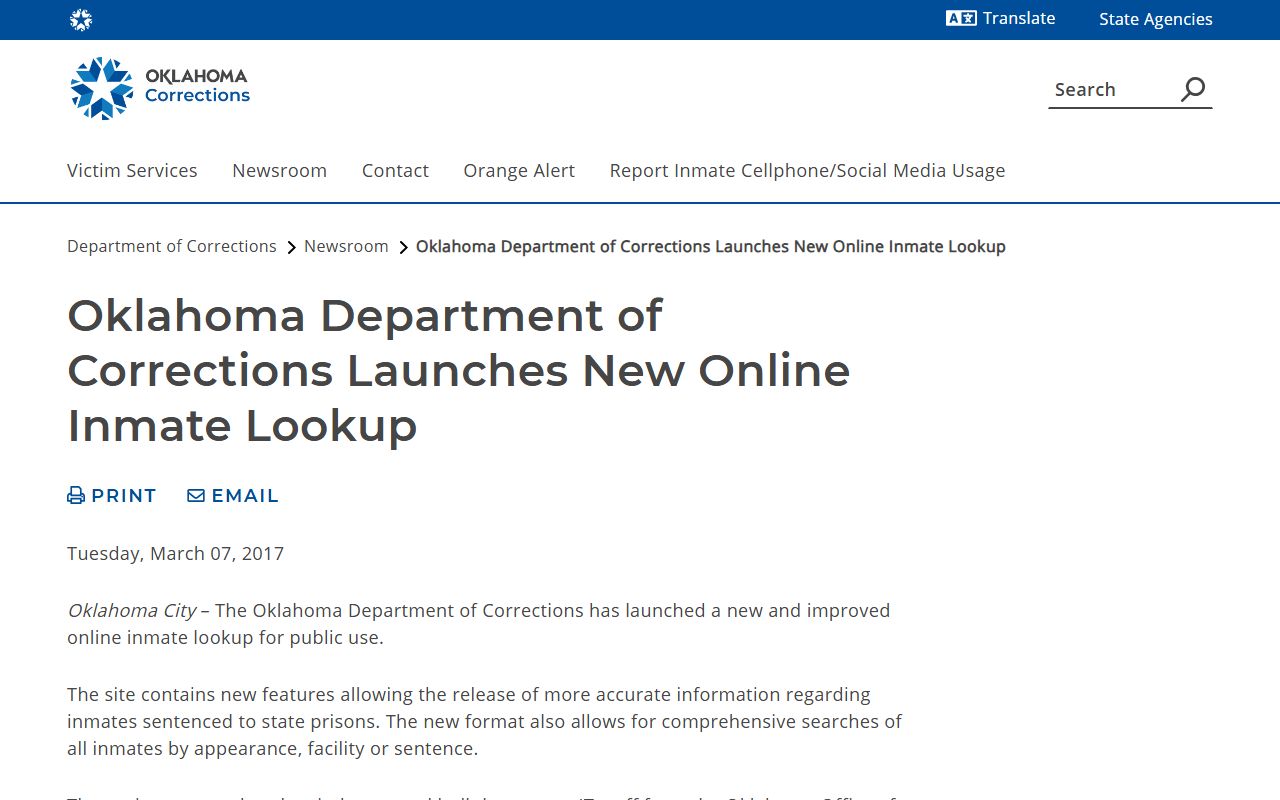
That source is useful for search-field vocabulary, while the current ODOC lookup disclaimer controls how cautiously a result should be read.
Oklahoma Detention Facilities
The Oklahoma facility roll-up includes ordinary county jails, county detention centers, jail-trust facilities, city lockups, municipal arrest logs, juvenile detention centers, tribal or regional detention, ODOC prisons, ODOC community corrections centers, BOP facilities, ICE or federal contract detention, and federal residential reentry. The statewide directory labels the facility type because the record path changes with the operator. A local arrest does not go to ODOC just because the person is in Oklahoma, and an ODOC sentence does not go to a county roster after transfer unless county backlog or temporary housing applies.
Browse the full Oklahoma Facility Directory →
The Oklahoma Department of Corrections facilities directory screenshot shows the state prison, community corrections, contract placement, and weekly-count source used for ODOC facility routing.
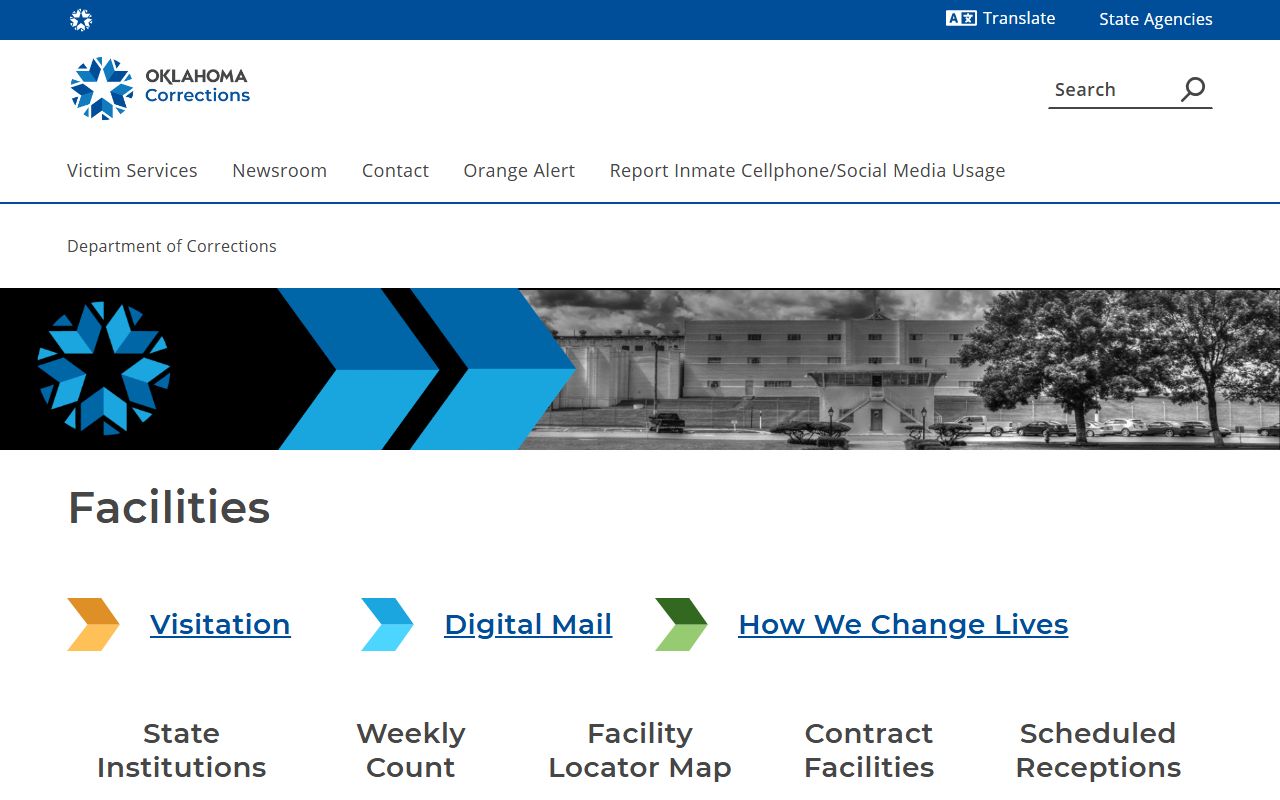
Facility routing matters in Oklahoma because ODOC naming, county custody, federal custody, and immigration contract detention can overlap in the same statewide search task.
Oklahoma Visits and Mail
Visitation, mail, phone, and commissary rules are set by the holding facility, not by one statewide jail rule. County jails use local schedules and local vendors. ODOC prisons use ODOC visitation rules. Federal facilities use BOP rules. ICE detention facilities use federal and facility-specific instructions. Confirm the holding site before sending mail, scheduling a visit, or adding money to an account.
ODOC visitation has a specific statewide rule set. The ODOC visitation page says visits must be scheduled, walk-ins are not accepted, and requests are due by Wednesday at 1 p.m. The same page routes questions to the visitation unit. Those rules apply to ODOC facilities, not county jails. County pages and facility pages should be used for local detention schedules.
Note: Confirm the exact facility before visiting or sending funds because Oklahoma county jails, ODOC prisons, BOP sites, and ICE facilities use different rules.
Oklahoma Public Records Requests
Oklahoma's Open Records Act appears in Title 51, Sections 24A.1 through 24A.30. For jail and arrest material, the research identifies 51 O.S. Section 24A.8 as the main statewide starting point for law-enforcement records available for public inspection. The request should go to the agency that made or holds the record. A county booking record, local jail incident record, booking image, or local roster issue belongs with the sheriff, jail trust, city police department, or detention center. An ODOC policy, ODOC inmate record, public inmate data request, state prison incident, or statewide count-data request belongs with ODOC.
Medical records, release dates, and transfer dates require more care. ODOC has a separate inmate medical records request channel. ODOC also states that release dates are confidential unless the requester can show a legitimate need, and transfer dates are not provided for confidentiality and security reasons. That means an Oklahoma public-records request is not a release-date calculator. For court filings after an arrest, use Oklahoma court portals and the county clerk channel rather than a jail roster.
The Oklahoma VINELink portal screenshot shows the custody-notification path that can supplement a roster search when release or transfer alerts matter.
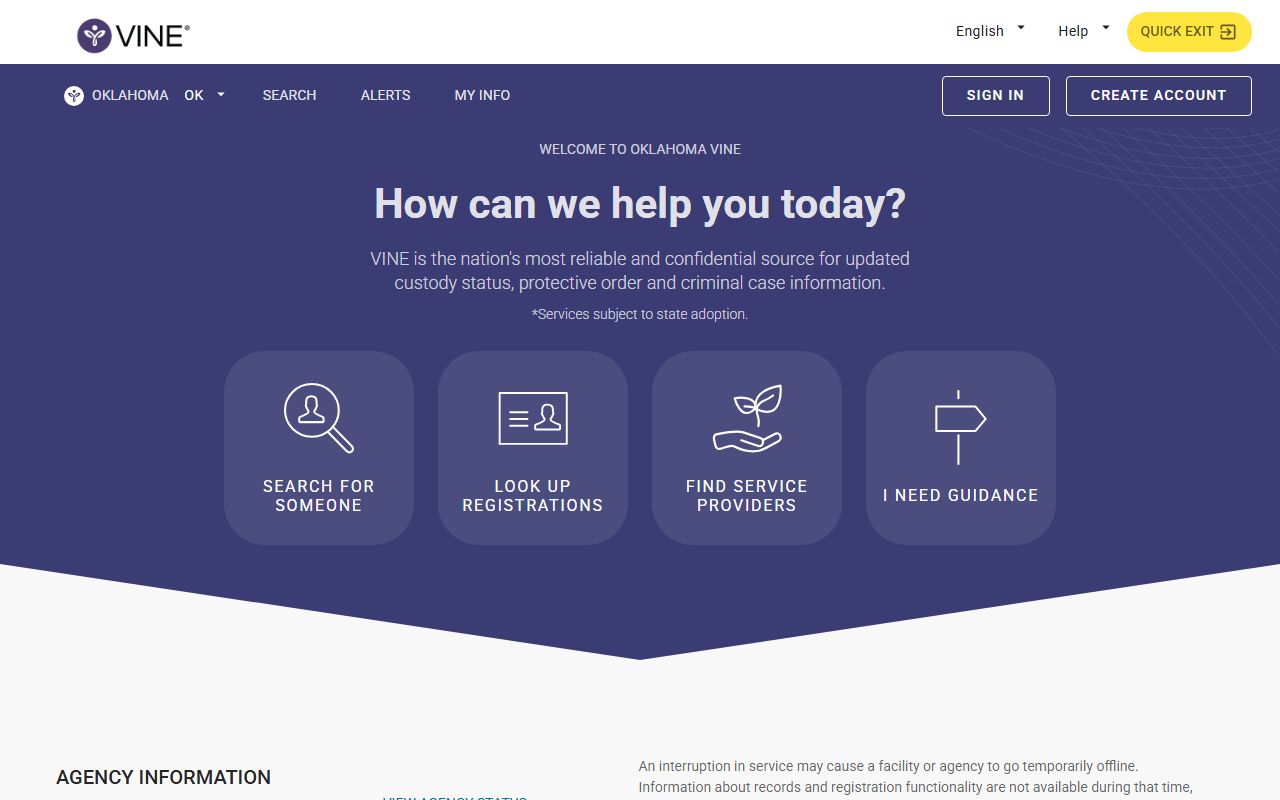
VINELink is useful for notification, but it does not replace ODOC, BOP, ICE, county rosters, or court records for the underlying custody or case file.